
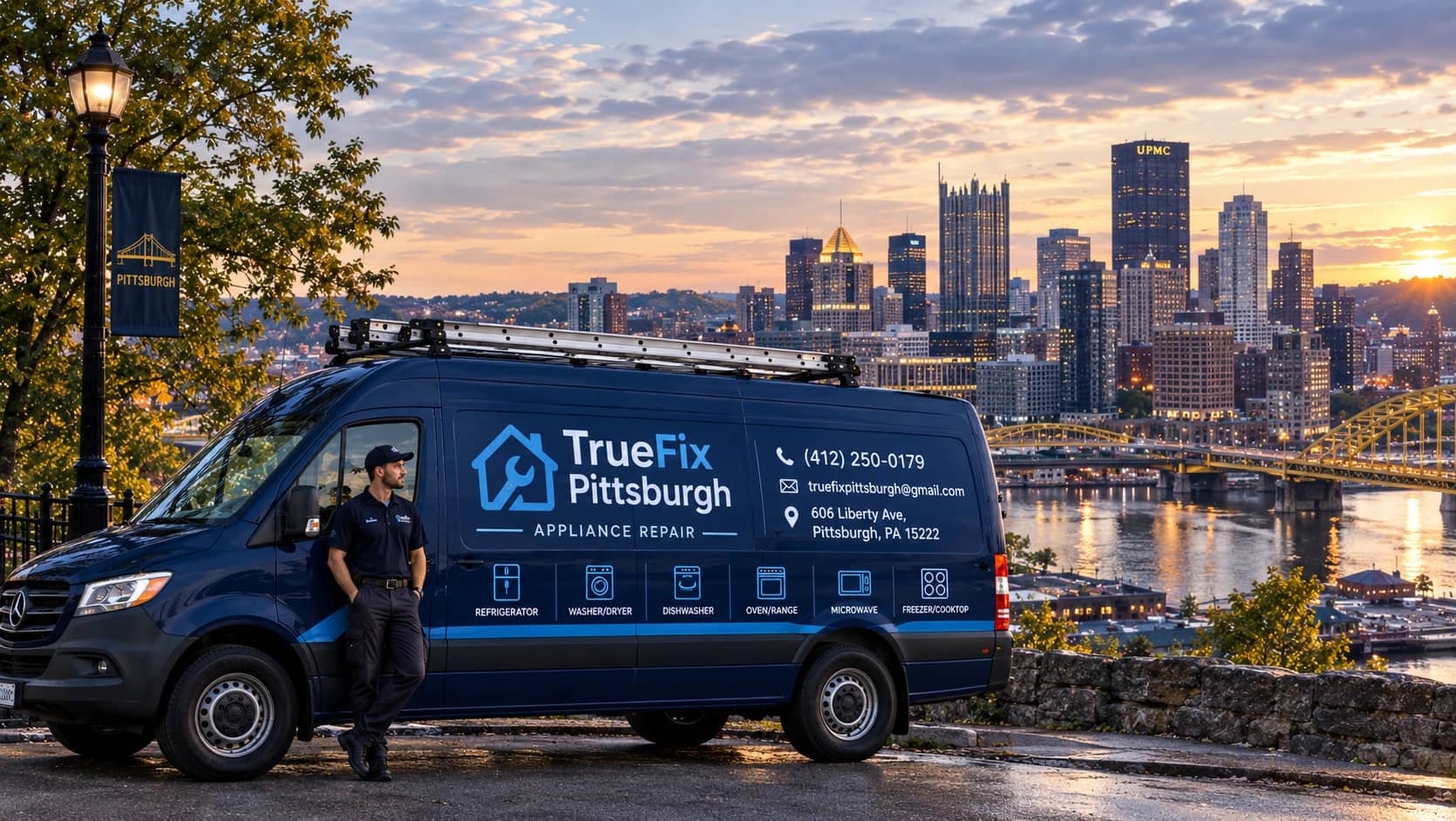
Allegheny County is a patchwork. It has 130 municipalities, and the City of Pittsburgh is only one of them, made up of about 90 neighborhoods. Around the city sit dozens of boroughs and townships, each its own local government, from Dormont and Wilkinsburg to Mt. Lebanon, Ross and Fox Chapel.
For appliance repair, that patchwork mostly matters in practical ways: where the technician can park, how the appliance is reached, and what kind of house it's in. This page explains how our service works across the parts of the county we cover.
Where we work
We serve twelve areas in Allegheny County. Four of them are made up of City of Pittsburgh neighborhoods:
- •Downtown, the Strip District and Uptown
- •Oakland and Shadyside
- •East Liberty, Squirrel Hill and the East End
- •The North Side
The other eight are, or include, separate boroughs and townships, often alongside city neighborhoods:
- •Bellevue, West View and the North Hills
- •Millvale, Etna, Aspinwall and Fox Chapel
- •South Side, Mount Washington, Hazelwood and Homestead
- •Dormont, Brookline and the South Hills
- •Mt. Lebanon, Upper St. Clair and Pleasant Hills
- •The West End, Crafton and the Airport Corridor
- •Wilkinsburg and Swissvale
- •Penn Hills and Plum
A mailing address that says "Pittsburgh, PA" doesn't always mean the City of Pittsburgh. Plenty of suburban townships use Pittsburgh addresses. When you book, the ZIP code is what tells us which area you're in. The full list of ZIP codes is on our service areas page.
How a visit works, anywhere in the county
The process is the same in a Lawrenceville rowhouse and a split-level in Plum:
- You book by phone or online and describe the problem, with the model number if you have it.
- A technician comes to your home and diagnoses the appliance where it stands.
- They explain what failed and give you a price for the repair.
- Nothing is done until you approve that price.
- If the repair isn't worth doing, you'll hear that plainly.
When a part isn't on hand, it's ordered by model number: manufacturer parts where they're available, with any equivalent part named as such.
What access looks like in different parts of the county
Pittsburgh's geography and its housing stock shape a lot of repair visits. None of it is a barrier, but it helps to plan for.
Older city neighborhoods
In places like Bloomfield, Polish Hill, Lawrenceville and the South Side Slopes, streets are narrow and on-street parking is tight. Some neighborhoods have residential permit parking. If you have a driveway, a garage pad or a visitor permit, tell us when you book. If the house sits up a flight of city steps or a steep walk from the street, mention that too.
Many of these homes are brick rowhouses or older detached houses with basement laundry. Basement stairs in pre-war homes can be steep and narrow, with low headroom at the bottom. That affects how a washer or dryer is pulled out for service and, if it ever comes to it, how a replacement gets in.
Apartments and high-rises
Downtown, the Strip District, Oakland and Shadyside have a lot of apartments and condominiums. Buildings often have their own rules: a loading dock, a service elevator that has to be reserved, or a management office that needs notice before a contractor arrives. If you rent, the appliance may belong to the landlord, and it's worth checking with them before booking.
Boroughs and townships
The suburban areas we cover range from dense pre-war boroughs, such as Dormont, Wilkinsburg, Millvale and Etna, to postwar neighborhoods of ranches and split-levels in Penn Hills, Plum, Baldwin and the North Hills. Parking is usually easier, but garages add their own questions, especially a second refrigerator or a freezer that lives out there in winter.
How the seasons show up in repair calls
The weather here is hard on some appliances in predictable ways, and it's worth knowing which symptoms are seasonal before assuming a part has failed.
- •Winter. A second refrigerator or chest freezer in an unheated garage, porch or basement can stop behaving when the room gets very cold, because many models are built for a heated space. The owner's manual lists the room temperature range the model was designed for. Supply hoses and dryer vents that run along outside walls can freeze, and a dryer hood can ice shut or disappear under a snowbank.
- •Spring and wet spells. Damp basements are common in older homes. Moisture is hard on the metal cabinets, motors and connections of washers, dryers and basement freezers over time.
- •Summer. Heat and humidity make refrigerators and freezers work harder, and a dusty condenser coil that coped in March may not cope in July. Thunderstorms bring power outages. After the power comes back, give a refrigerator several hours to recover before judging it, and keep the doors shut while it does.
If a problem started right after a cold snap, a storm or an outage, say so when you book. It often points straight at the cause.
What to have ready
A few details make any visit go more smoothly:
- •The model and serial number, from the label on the appliance. A phone photo of the label is ideal.
- •What happens and when. Error codes, noises, whether it's constant or intermittent.
- •Access notes. Parking, stairs, building rules, gate codes, pets.
- •A clear path to the appliance and a little space around it.
- •Warranty status. If the appliance is still under the manufacturer's warranty, contact the manufacturer first. We're independent, not an authorized service center.
What we repair
We work on refrigerators, freezers, washers, dryers, dishwashers, ovens, ranges, cooktops, microwaves, ice makers and wine coolers, across a long list of brands. The appliance repair page and the brands page have the details.
To set up a visit anywhere in our area, call or book online.